Let's be honest about how most great things actually get built.
Not with a 47-slide roadmap and a perfectly color-coded Notion board.
More like — someone stayed up until 2 AM, tried something stupid, accidentally discovered something brilliant, panicked, reverse-engineered why it worked, and then told everyone they "had a vision."
That's the dirty little secret behind almost every startup, every viral content creator, and every app you've used in the last ten years.
But here's the thing nobody tells you: there is a structure to all that beautiful chaos.
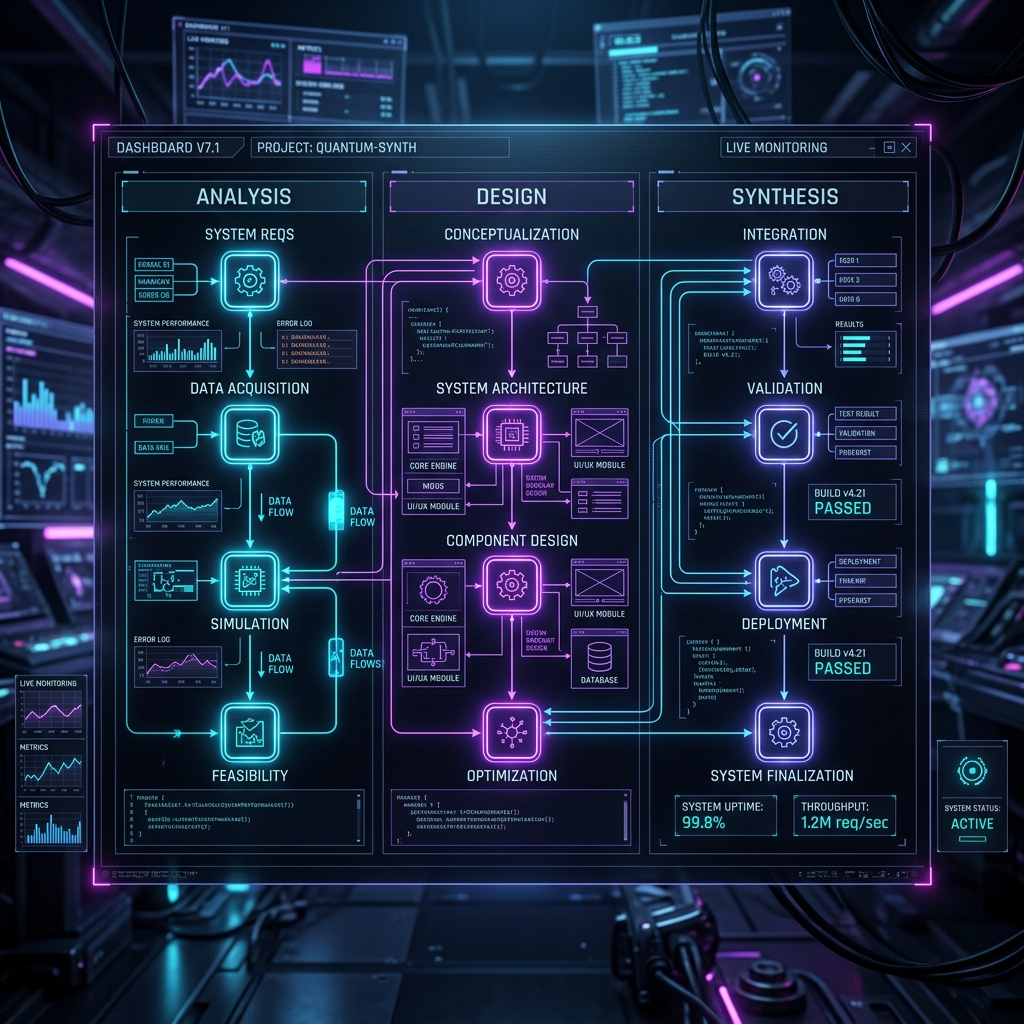
It's called Analysis, Design, and Synthesis. And it doesn't live in your textbook's chapter summaries. It lives in the messy, hilarious, slightly catastrophic way real people actually build things.
Let's get into it.
Every Big Thing Starts With Curiosity (And Usually Confusion)
Think about the apps sitting on your phone right now: Instagram, LinkedIn, YouTube, WhatsApp.
None of them became what they are because someone had a perfect plan from day one. Instagram started as a location check-in app. YouTube had no clue people would upload everything from cooking videos to university lectures. LinkedIn was basically a digital résumé dump before someone figured out that "storytelling" was cringe but also impossible to stop scrolling through.
What actually happened at every one of these companies was a cycle. Experiment. Observe. Break something. Fix it. Try a weird idea. Kill it. Try another one.
Sound familiar?
That cycle has three names: Analysis, Design, and Synthesis.
And a bonus, unofficial fourth step: "Let's just see what happens."
Analysis — Observation Before Opinion
Analysis is simply the act of understanding what's actually happening. Not what you assume is happening. Not what your gut says. Not "bro trust me." Actually looking.
Here's the difference between analysis and vibes:
Scene: Your class attendance drops below 30%. Person A: "Students are lazy." Person B: Notices lectures are at 8 AM. Realizes half the class commutes. Figures out nobody learns from slides anymore. Sees that recorded videos would triple engagement. Person B is doing analysis. Person A is doing a hot take.
Same energy shows up on LinkedIn. Ever notice how the platform quietly shifted from stuffy "I'm pleased to announce" posts to raw storytelling and personal narratives? That shift wasn't an accident. Creators started observing — what stops people from scrolling, why relatable content outperforms polished corporate-speak, what makes someone hit follow.
The best creators don't just create. They watch first.
The "Analysis After Chaos" Speedrun
Here's the funny part though: analysis doesn't always come before the action. Sometimes it comes after the disaster.
Picture a student starting a project the night before the deadline. Panic. Bugs everywhere. Something breaks that was definitely "not their fault." And then, at 3 AM with three Red Bulls in their system, they have a genuine revelation about why planning matters, why Git exists, and why "I'll do it tomorrow" is just a polite lie you tell yourself.
That is also analysis. Just... acquired the expensive way.
Some people learn through observation. Others learn through consequences. Both are valid. One is just louder and significantly more humiliating.
Design — Turning the Chaos Into a Direction
Once you understand what's happening, the next question is: "Okay but... now what?" That's design.
Design is what happens when you take a pile of messy observations and half-baked ideas and try to make them point somewhere useful.
College hackathon, day minus three: Someone starts making posters. Someone else creates a WhatsApp group. One person reaches out to sponsors. Another person starts talking about reels. And then there's that one guy who suggests drones, laser shows, and a live DJ — for a ₹500 budget.
That whole magnificent disaster of a planning process? That's design. Not fancy UX wireframes. Not Figma prototypes. Just structured human beings trying to convert confusion into a direction.
Same thing for creators building an online presence. Choosing a content style, figuring out posting frequency, picking a visual identity, testing hook formats — all of it is design. Even memes are designed. Nothing on the internet is as spontaneous as it looks.
Synthesis — Where Plans Meet the Real World (And Get Humbled)
Synthesis is execution. The moment theory becomes reality. It is also the moment reality smacks theory across the face.
Fest day. Final preparations. The mic cuts out. Registration forms crash. Three volunteers have mysteriously vanished. Someone forgot extension boards. The design team is still exporting "final_final_ACTUAL_final_v9.png." And somehow — everything still comes together.
That messy, exhausting, slightly miraculous thing that just happened? That's synthesis.
App launch day: Users complain about things you never imagined. A feature breaks in production but somehow worked perfectly in testing. One tiny bug cascades into everything. A review calls your life's work "confusing and slow."
But this is also where real learning happens. Because execution reveals things that planning never could. You can't simulate how users actually behave. You can't predict every edge case. You can't fully understand a system until it's running. Synthesis is where design goes to grow up.
So Where Does "Fuck Around and Find Out" Fit?
Right in the middle of everything. Always. Because real growth is rarely a clean, linear path from idea to success. It looks more like:
- ↳Analyze first → then execute
- ↳Execute first → fail dramatically → then analyze afterward
- ↳Skip everything → get lucky → reverse-engineer why → tell everyone it was intentional
The best founders, creators, students, and builders usually live somewhere between two failure modes:
Failure Mode 1: Too much analysis, not enough action. (Overthinking. Planning everything. Doing nothing.)
Failure Mode 2: Too much action, not enough direction. (Running fast in seventeen wrong directions simultaneously.)
The sweet spot? Structured experimentation. Basically, intelligent "fuck around and find out."
Enough analysis to avoid stupid mistakes. Enough experimentation to avoid permanent paralysis.
The Real Formula (No One Puts It on a Slide)
Analyze a little.
Try something.
Fail a bit.
Redesign.
Improve.
Repeat.That's how startups evolve. How creators grow. How students somehow survive engineering. How apps become the kind of thing people can't put down. How people slowly, stubbornly figure life out.
Not through perfection. Through iteration.
Final Thought
Analysis, Design, and Synthesis aren't rigid textbook concepts reserved for exams and forgotten immediately after. They're the underlying logic of how anything real gets built — by students, by founders, by creators, by anyone who's ever tried to make something from nothing.
The cycle isn't always graceful. Sometimes it's three bug fixes at midnight and a presentation held together by pure confidence and a prayer. Sometimes it's a feature that breaks everything and teaches you more in one hour than six months of planning ever could.
But that's kind of the point.
The best things don't come from perfect plans executed flawlessly.
They come from people who tried something, learned something, improved something — and had just enough structure to keep going when the chaos got loud.
A little analysis. A little design. A little synthesis.
And always, always — a willingness to fuck around and find out.