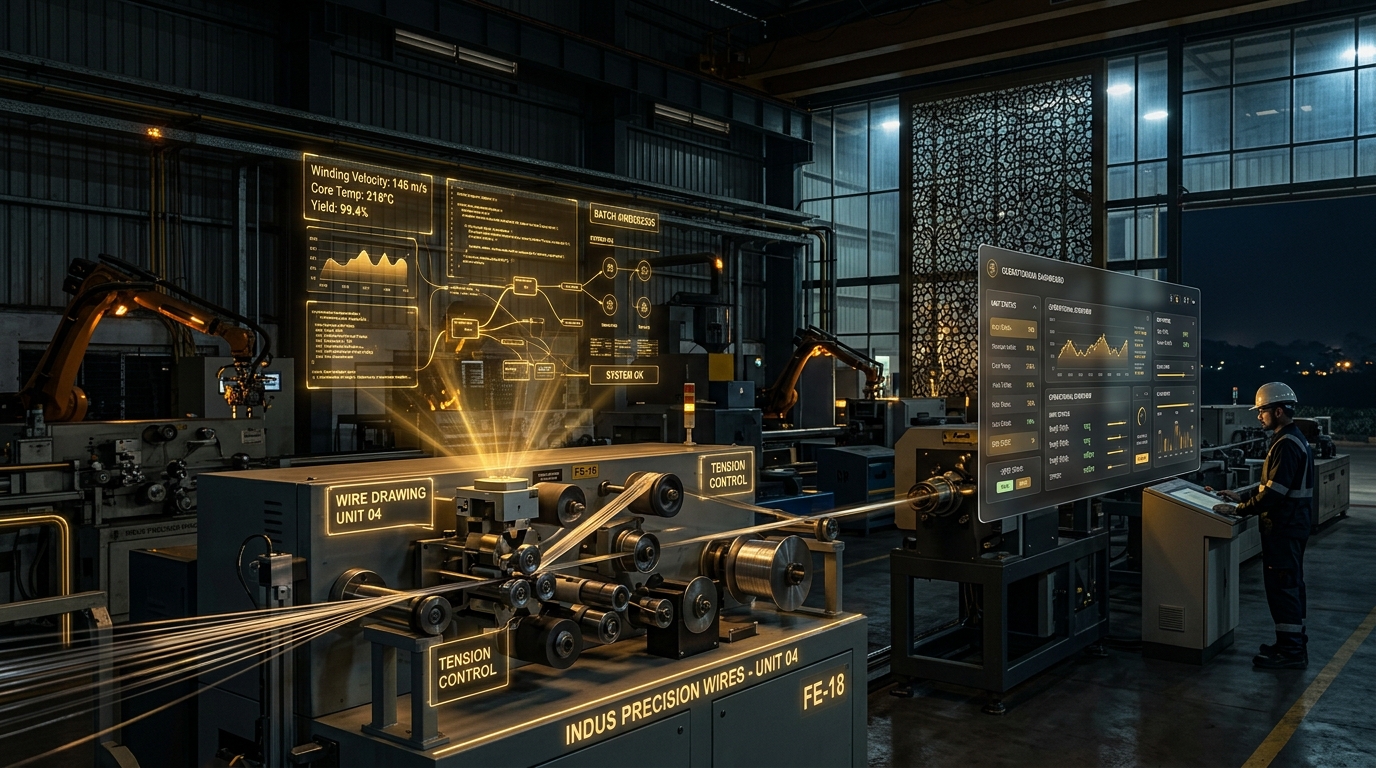
Aurangabad is one of India's most overlooked industrial ecosystems.
Within a 50-kilometer radius, hundreds of wire manufacturers, auto-component suppliers, fabrication units, and precision engineering companies quietly power supply chains for some of the country's largest brands. These factories produce millions of components every month, employ thousands of workers, and generate enormous economic value.
Yet many of them still operate with systems that haven't fundamentally changed in decades.
An Industrial Hub Hidden in Plain Sight
Aurangabad is home to more than 500 wire manufacturing units and hundreds of auto-component suppliers serving companies such as Bajaj Auto, Volkswagen, and Škoda Auto.
Despite this industrial density, digital adoption remains surprisingly low. Production records are often maintained on paper. Shift reports travel through WhatsApp groups. Machine utilization data is manually collected at the end of the day. Many factories rely on ERP systems implemented more than a decade ago, with little visibility into what is happening on the shop floor in real time.
The Gap Nobody Is Building For
Most enterprise software companies pursue large corporations with multi-crore budgets and long procurement cycles. Most startups focus on technology hubs like Bangalore, Pune, Mumbai, and Hyderabad.
That leaves an entire segment underserved: the regional manufacturer with 100–500 employees.
The wire manufacturing unit in Waluj tracking maintenance schedules on spreadsheets. The fabrication shop struggling to monitor machine downtime. The factory manager who knows production targets are slipping but has no live data to identify why.
What They Actually Need
These businesses need technology just as much as large enterprises. What they don't need is enterprise complexity or enterprise pricing. That's the gap we're building for.
Why Local Context Matters
Industrial software built for Germany, Silicon Valley, or even Mumbai often fails when deployed in regional manufacturing clusters.
Aurangabad has its own realities:
Technology designed without these constraints quickly becomes shelfware. The solution is not simply translating software into Marathi. It is designing systems that are offline-first, resilient, simple to operate, and aligned with how factories actually work.
The Local Engineering Advantage
Every year, engineering colleges across Aurangabad produce thousands of graduates. Most leave immediately for Pune, Bangalore, or other metropolitan cities in search of opportunities.
We believe there is another path.
When local engineers build products for local industries, something powerful happens. They understand the machines, the workflows, the people, and the language. Problems are identified faster. Solutions are adopted more easily. Trust is built naturally.
A factory manager is far more likely to adopt a new system when support comes from someone who understands both software architecture and shop-floor operations. That creates a talent-to-market loop that strengthens over time.
Building the Digital Infrastructure of Regional Manufacturing
The future of Indian manufacturing will not be defined only by mega-factories and industrial parks. It will also be shaped by thousands of regional manufacturers that form the backbone of the country's supply chain.
Their challenge is not a lack of capability. It is a lack of accessible, practical, and context-aware technology. The opportunity is enormous.
By helping these businesses digitize operations, improve visibility, and make better decisions, we are not just building software. We are helping create the digital infrastructure that regional manufacturing needs for the next decade of growth.
And Aurangabad is the perfect place to start.