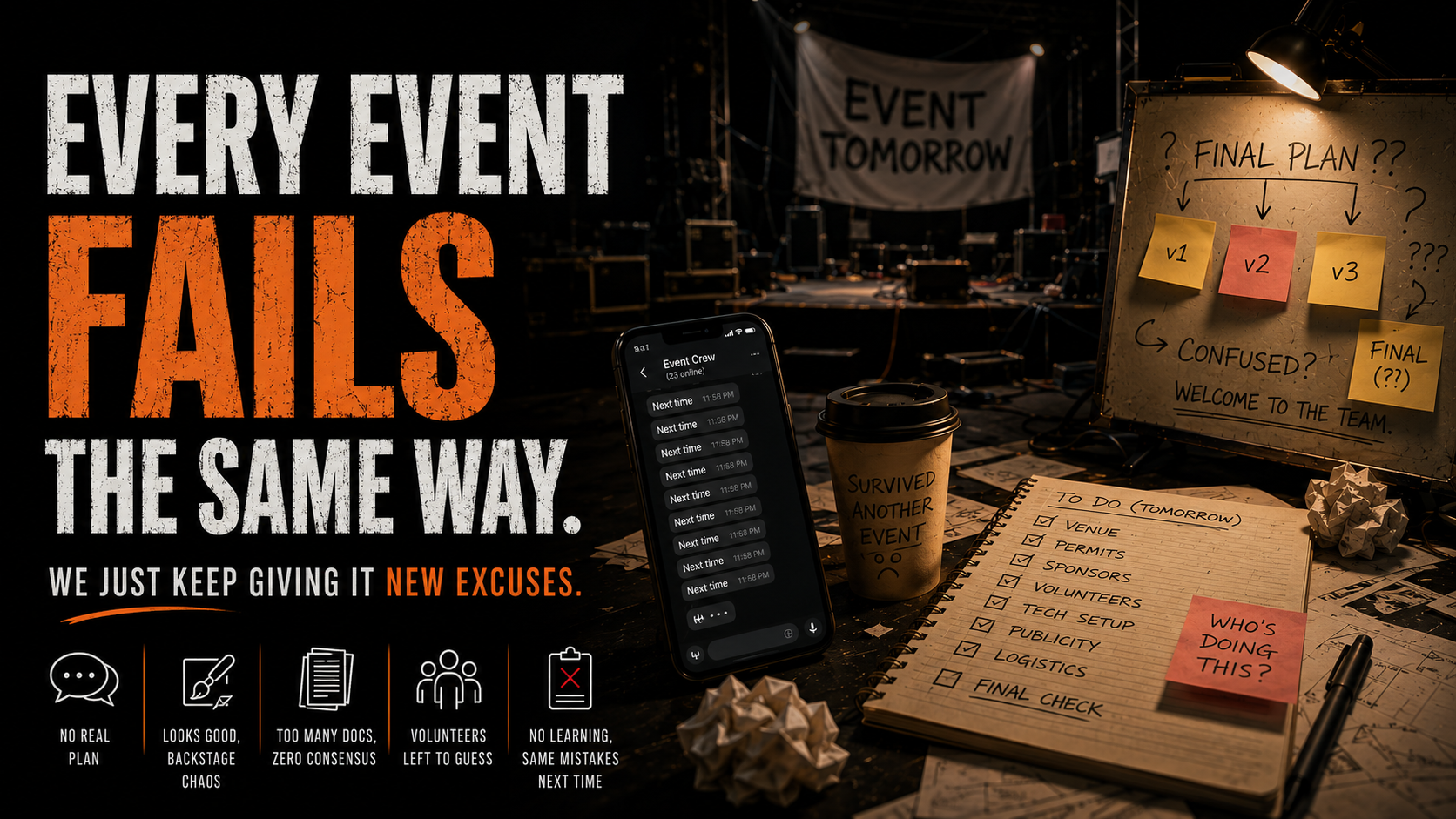
If you've ever been on an event team — college fest, hackathon, community meetup, doesn't matter which — you already know the ending before it happens.
Something breaks at 11 PM the night before. Someone says “how did we not see this coming.” Everyone agrees to “plan better next time.” Next time arrives. Same ending, new cast, same amount of shock as if this had never happened before in the history of events.
Here's the part nobody wants to admit:
It's not five different disasters. It's one disaster, wearing five different costumes, doing a very convincing job of looking new each time.
The Group Chat That Thought It Was a Plan
Every event starts the same way. Five people, one shared burst of energy, ideas flying faster than anyone can catch them. Genuinely a great vibe. Ten out of ten opening scene.
The problem is it never leaves that scene. It just sort of… stays in idea-mode forever, suspended somewhere between message 340 and 341 of a WhatsApp thread three people have already muted. A venue gets picked because someone felt strongly about it at 1 AM, not because anyone asked “and if the generator doesn't show up?”
Enthusiasm was never the issue. Enthusiasm with nowhere to land, on the other hand, is basically a WhatsApp group with extra steps.
The Poster Is a Masterpiece. The Backstage Is Improv Theatre.
This one's the sneaky one, because it doesn't announce itself as a failure. It shows up dressed as competence.
The reel drops three days early. Someone spent six hours perfecting a gradient nobody will remember by lunch. The stage has a whole mood board. From the outside, this team has it together.
Meanwhile, exactly nobody has checked whether there's a backup mic, extension boards are assumed to exist, and the budget quietly funneled itself into things that photograph well—leaving sound, seating, and crowd flow to whoever happens to be standing nearby looking mildly concerned.
The visible ten percent got a design process. The invisible ninety percent got vibes and a prayer.
Four Docs, Two Groups, One Verbal Instruction, Zero Consensus
This is the version that's almost impressive in how organized it looks while functioning exactly like chaos.
There's a doc. There's a group. Meetings happened, minutes were taken, someone even made a Gantt chart nobody has opened since. Good so far.
Except there are also three otherdocs. And two other groups. And one verbal instruction, delivered in a hallway with total confidence, to exactly one person who assumes everyone else got the memo too. People guess, confidently, and those guesses stack on top of each other until the “plan” is less a document and more a rumor with a deadline attached.
“Just Handle It” Is Not a Training Program
Volunteers are usually the largest group at any event and the one handed the least context. They get a task, a location, and a “just handle it,” which sounds like trust but is actually the polite absence of an answer to what happens when things go wrong.
So when a form won't load or a schedule slips 15 minutes, it breaks in parallel across stations as fifty volunteers independently invent their own solutions on the spot.
A system built for a room of six, deployed on a crowd of sixty, and never once asked whether it would survive the jump.
Everyone Goes Home. The Learning Doesn't Even Get Invited.
The event ends. Everyone's relieved it's over. The instinct is to close the laptop and never speak of the extension board incident again.
So nobody writes it down. All of it leaves the building in people's heads and evaporates. Which means the next event restarts from zero. Same missing direction, same competing docs, same volunteers left to guess.
This isn't a sixth failure. It's the reason the first five get a sequel every single time.
The Loop, Not the List
Line these five up and they stop looking like five unrelated disasters. They start looking like the same gap, showing up at five different points on the same timeline.
Build that loop, and these five stop being fate. They turn into a checklist.