Most IoT demos look impressive: a sensor reports data, a dashboard updates in real time, an alert appears when something goes wrong. Everything works perfectly.
Then you deploy it in the real world. That's where the real engineering begins.
The Problem Nobody Can See
Fuel theft is one of the most expensive hidden costs in commercial transportation. Across India's logistics ecosystem, fleet operators lose thousands of crores annually to unauthorized fuel siphoning, inaccurate reporting, and undetected leakages.
The challenge isn't discovering the theft afterward. The challenge is knowing it is happening while it is happening.
Existing solutions generally fall into two categories:
We believed there was room for something different: an affordable, reliable system capable of operating in the unpredictable conditions of Indian transportation networks. That became FuelShield.
The Architecture
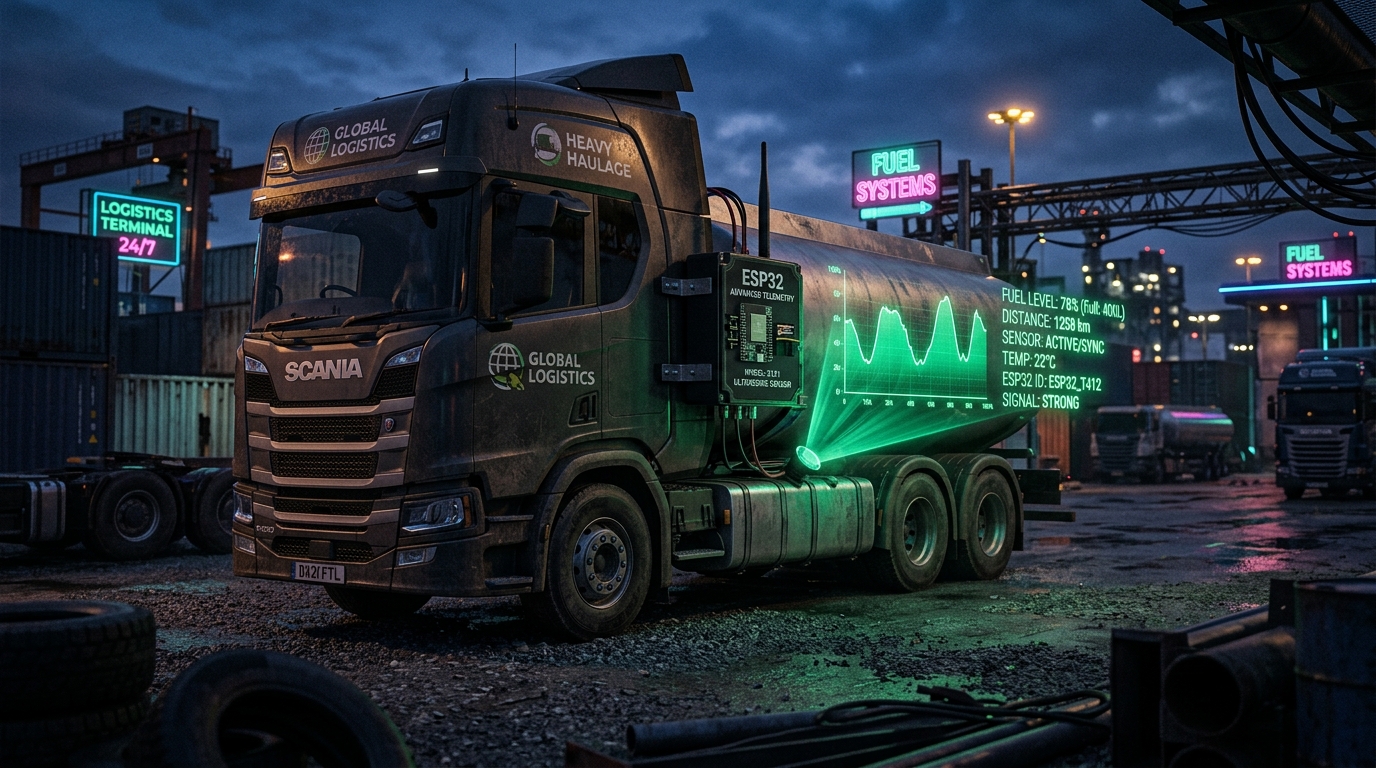
At its core, FuelShield is intentionally simple. An ultrasonic sensor measures fuel levels inside the tank, an ESP32 microcontroller processes readings locally, and only meaningful events are transmitted to the cloud.
// FuelShield Data Pipeline
Anomaly detection happens directly on device. The cloud receives alerts; the edge device makes decisions.
Detecting Theft Without Detecting Normal Usage
The first assumption we made was wrong. Initially, it seemed obvious that fuel theft could be identified by monitoring sudden drops in fuel level.
The problem is that fuel levels naturally decrease during operation: engines consume fuel, vehicles climb hills, fuel sloshes inside tanks, and sensors experience noise.
The Solution: Measuring Rate of Change (Velocity)
A commercial diesel engine consumes fuel gradually over time (0.8–1.2L/hr). A siphon theft event removes fuel dramatically faster (10–15L/min). Once we shifted our detection model from quantity to velocity, accuracy improved to 99.2%.
What the Field Taught Us
The biggest lessons did not come from coding. They came from truck yards.
- Sensors remain stable
- Power supplies are clean
- Networks stay connected
- Hardware stays mounted
- Tanks vibrate continuously
- Diesel fumes degrade seals
- Power fluctuates & spikes
- GSM signals vanish for hours
Designing for Failure & Offline Resilience
One of the most important lessons was that connectivity cannot be trusted. Assuming continuous internet access would have made the system unusable.
Instead, FuelShield was designed as an offline-first platform: readings, detection, and alerts are queued locally in a 50-event buffer and automatically sync when network returns.
The Biggest Lesson
After more than a hundred hours spent around trucks, workshops, fleet operators, and service technicians, one lesson stands out:
Technology does not operate in controlled environments. It operates in reality. Reality is noisy, unpredictable, and breaks assumptions.