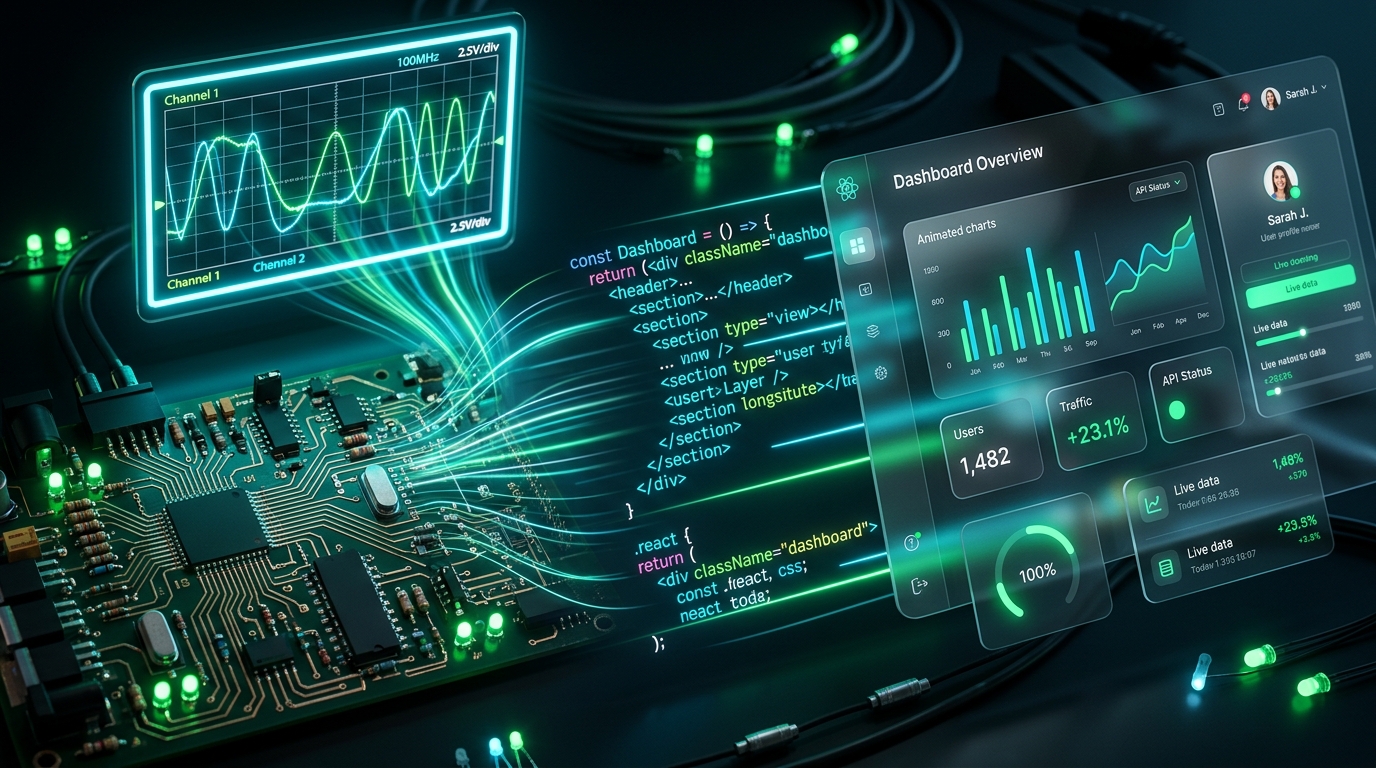
When I started my B.Tech in Electronics and Communication Engineering, I spent most of my time buried in circuit theory: BJTs, operational amplifiers, communication systems, transmission lines.
At the time, it all felt disconnected from the products I actually wanted to build. I could calculate gain, analyze filters, and solve network equations on paper, but I had no idea how any of it connected to the software powering the modern world.
Meanwhile, software developers seemed to be building things that people actually used—web applications, mobile apps, dashboards, platforms. The two worlds appeared completely separate.
I eventually learned they weren't.
The Industry's Artificial Divide
Engineering education often creates a false distinction. ECE students learn how electrons move through circuits. Computer science students learn how data moves through software.
Each group becomes highly specialized. And both groups miss half the picture.
The products shaping the world today rarely live in a single domain:
The boundaries only exist in classrooms. The products themselves don't care.
The Mental Model That Changed Everything
The breakthrough happened when I stopped viewing hardware and software as different disciplines. Instead, I started viewing them as the same engineering problem expressed at different abstraction levels.
The terminology changes. The underlying thinking doesn't. Both disciplines are ultimately about moving information reliably through imperfect systems.
Debugging Taught Me More Than Theory
One of the most surprising discoveries was how transferable debugging skills became. Tracking voltage drops across a circuit board and tracing state transitions through a React application require identical reasoning.
You form hypotheses. You isolate variables. You measure behavior. You identify where reality diverges from expectation.
Good engineers are rarely defined by the technologies they know. They're defined by how they investigate problems.
Why This Combination Is Rare
Most engineers spend their careers operating within a single layer. Some become experts in embedded systems. Others specialize in cloud infrastructure. Others focus entirely on frontend development.
There's nothing wrong with specialization. But interesting opportunities often appear at the boundaries:
- The engineer who understands both hardware sensors and high-framerate web interfaces.
- The developer who can troubleshoot an MQTT packet communication failure and a React rendering issue on the same afternoon.
- The builder who understands both the physical world and the digital one.
Building Across the Entire Pipeline
This realization eventually shaped how we build products. We don't think in terms of hardware projects or software projects—we think in terms of systems.
A sensor reading isn't useful until it reaches the right person. A dashboard isn't useful if the data feeding it is unreliable. An alert isn't useful if network delays make it arrive too late.
The real challenge isn't building individual components. It's ensuring those components work together as a single system.
Advice for ECE Students
If you're studying electronics today, don't wait for the curriculum to connect the dots.
Pick a sensor → Connect it to a microcontroller → Send data to the cloud → Create a dashboard → Deploy it.
Watch how concepts from communication systems, digital electronics, networking, databases, and frontend development suddenly start intersecting.
The Bigger Lesson
The most valuable thing my electronics background gave me wasn't knowledge of circuits. It was systems thinking: the ability to view products as interconnected layers rather than isolated technologies.