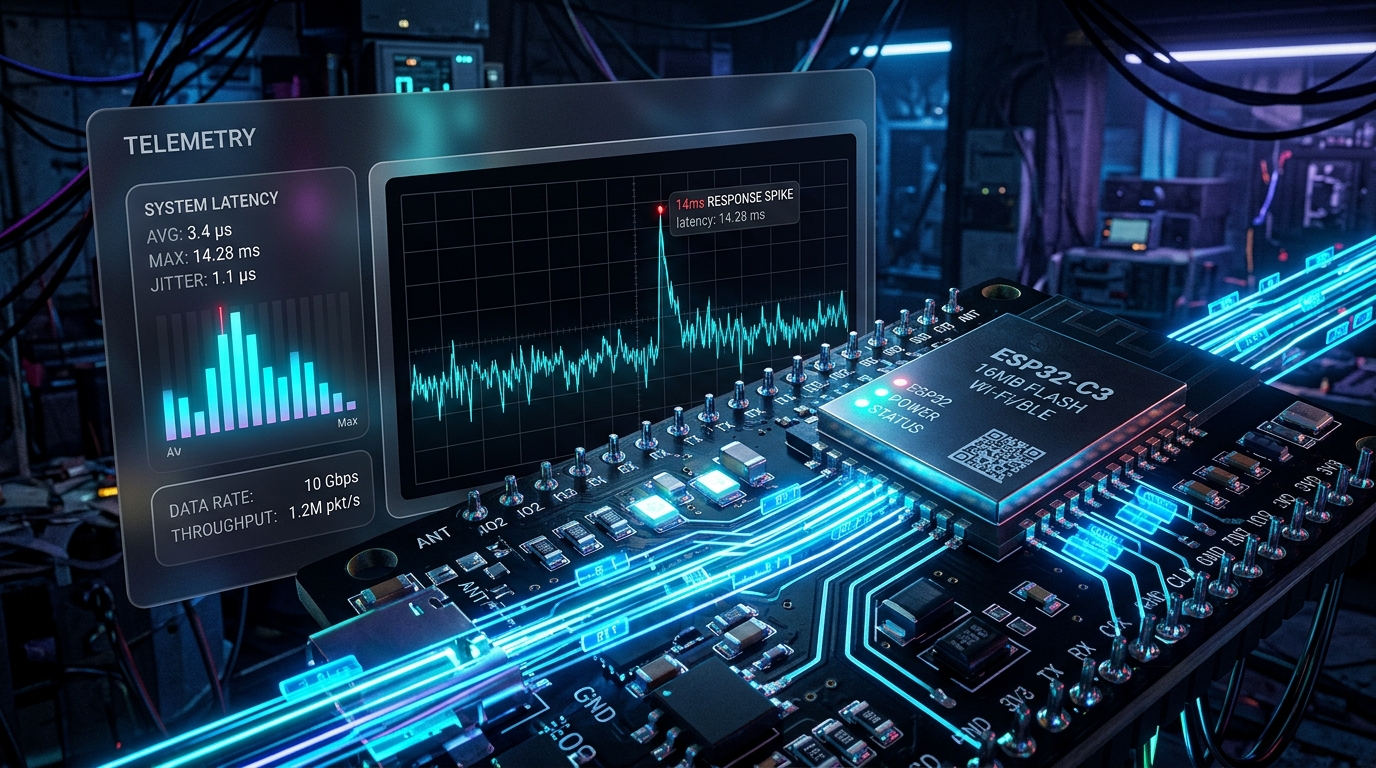
Most software companies talk about features. We talk about milliseconds.
Because in industrial environments, the difference between a system responding in 14 milliseconds and 500 milliseconds isn't merely performance—it's the difference between acting on a problem and discovering it after the damage is already done.
The Human Side of Latency
Humans perceive delays in roughly three categories:
For a social media app, an extra half-second is annoying. For a factory floor, it can be expensive.
Operators make decisions based on what they see. If the data arriving on a dashboard is already half a second old, they are reacting to the past rather than the present. The faster a machine moves, the more dangerous that gap becomes.
When Milliseconds Become Physical Distance
Consider a spindle rotating at 1000 RPM.
A traditional cloud-based monitoring system with a 500ms delay means the machine completes more than eight rotations before the operator even sees the alert.
By the time the warning appears, the event that triggered it has already happened. The machine doesn't care that the dashboard is still waiting for a database write.
Physics moves first.
Software catches up later. Our goal is to make that gap as small as possible.
Why Edge Processing Matters
Most industrial monitoring systems follow a familiar path:
Every step adds latency. Every network hop introduces uncertainty. Every dependency becomes another point of failure. We take a different approach:
Instead of sending raw data to the cloud and waiting for a response, detection happens directly on the device collecting the data. The result is immediate action rather than delayed analysis. An order-of-magnitude improvement.
What 14ms Actually Means
The number isn't theoretical. It's measured end-to-end on a stable local network:
| Component Layer | Measured Latency |
|---|---|
| Edge Detection (ESP32 On-Chip) | 2ms |
| Local MQTT Publish | 4ms |
| WebSocket Delivery | 6ms |
| React Dashboard DOM State Update | 2ms |
| Total End-to-End Latency | 14ms (1 Frame @ 60 FPS) |
That means a threshold breach detected by a sensor appears on the operator's screen in approximately one frame at 60 FPS. At that point, the limiting factor is no longer technology — it's human reaction time. And that's exactly where it should be.
Real-Time Means More Than Fast
Many industrial platforms advertise “real-time monitoring.” What they often mean is data refreshed every few seconds.
That's useful for reporting. It's not useful for intervention.
Real-time systems should allow operators to act while an event is still happening, not after it has already finished. That requires software architecture designed around speed from the beginning, not added later as an optimization.
The Engineering Philosophy
We don't chase low latency because it looks impressive in benchmarks. We chase it because every millisecond removed from the system reduces the gap between reality and information.
The closer those two become, the better decisions people can make. In industrial environments, that means less downtime, faster responses, safer operations, and more confidence in the systems people rely on every day.
Fourteen milliseconds isn't the product. It's what happens when every layer of the product is designed around a simple idea: