
There's a particular kind of argument that only happens when nothing is at stake, and it's usually the best kind.
Vedant, Om, and I were three cups of chai into a Tuesday evening when Vedant mentioned something his senior had thrown at the team that morning: is electric current a scalar quantity or a vector quantity?He already knew the answer — this wasn't curiosity, this was a man setting a trap and watching two idiots walk into it. Om said scalar, with the confidence of someone who'd once read a textbook. I said vector, with the confidence of someone who hadn't. Vedant didn't referee. He just watched, visibly delighted, trying to reverse-engineer how two grown adults had arrived at two different wrong answers using what appeared to be pure vibes.
The Uncomfortable Reality
It's a tensor, by the way. Neither of us was right. A tensor is the annoying answer that shows up when you've built your whole argument on a binary and reality declines to cooperate — magnitude, direction, and the specific plane it acts on, all at once, refusing to pick a team.
Something about that felt appropriate. We'd spent twenty minutes being confidently, symmetrically wrong, and the universe's response was to hand us a third option neither of us had the vocabulary for.
Here's what I keep coming back to, though — none of us had any business being in that conversation.
Vedant's a mechanical engineer. Om lives in code. I've spent this year alone bouncing between IoT builds, event logistics, half-finished web projects, and blog posts about things I wasn't thinking about the day before. There's actually a word for people who wander this far outside their own lane for no reason — intellectual omnivores. Scavengers, not specialists. On paper, none of us should have cared whether current has a direction. It's not on anyone's syllabus this semester, it wasn't going to fix anyone's bug, and Vedant's senior definitely wasn't grading us. We just didn't want to be the one who didn't know.
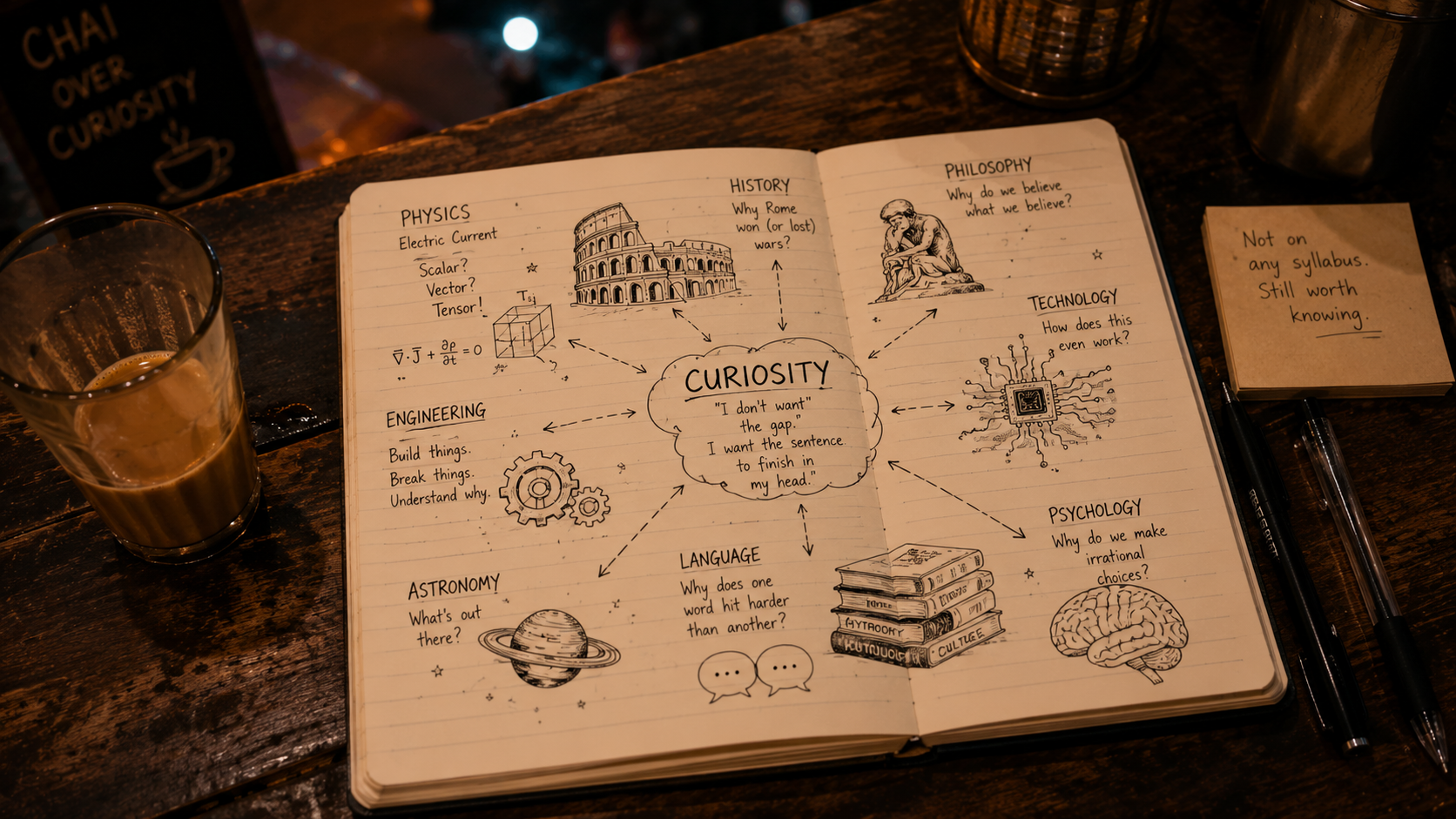
That's a strange thing to admit is a motivator. Not “I need this.” Just — I don't want the gap. I want the sentence to finish in my head.
I think that's most of what curiosity actually is, once you strip the poetry off it. Not some noble hunger for truth. Just a low-grade discomfort with unfinished thoughts. It's the same itch that makes you keep scrolling a Wikipedia page about a war you have no personal connection to, or watch a twelve-minute video on how they build tunnels, at 1 a.m., for reasons you couldn't defend to anyone. You're not going to use it. You just can't leave it half-known. It's a very budget version of Tony Stark casually announcing he mastered a new branch of physics overnight — ours just comes as a WhatsApp voice note about tensors instead of a suit that flies.
What's a little funny is that we spend a lot of institutional energy trying to train this instinct out of people. Pick a major. Specialize. Stay in your lane, it's more efficient. And it ismore efficient — you don't build a bridge by having the structural engineer also learn Ottoman history that week. But nobody actually manages to fully comply. The same engineer who stays rigorously in-lane at work will go home and fall into a three-hour hole about why the Roman army's supply lines actually decided most of its wars. The lane-staying is real. It just quietly ends around 7 p.m.
I don't think this is some grand statement about the pursuit of knowledge. I think it's smaller and pettier than that, and that's what makes it funny. We didn't debate current because we were passionate about physics. We debated it because none of us wanted to be the one to say “I don't know” and mean it. And somewhere underneath that small, slightly competitive itch is the same mechanism that's apparently responsible for, over a few thousand years, all of science, most of religion, and every long Wikipedia rabbit hole anyone's ever fallen into on a Tuesday.
We just call the big version “civilization” and the small version “arguing about vectors over chai.” Same itch. Different stakes.