ESP Car
Wi-Fi Controlled Smart Robotic Vehicle & Telemetry OS
Powered by ESP8266 NodeMCU, L293D dual motor H-bridge driver, and low-latency Blynk IoT Virtual Pin stream controls engineered under the Ugam Campus Engineering Framework.
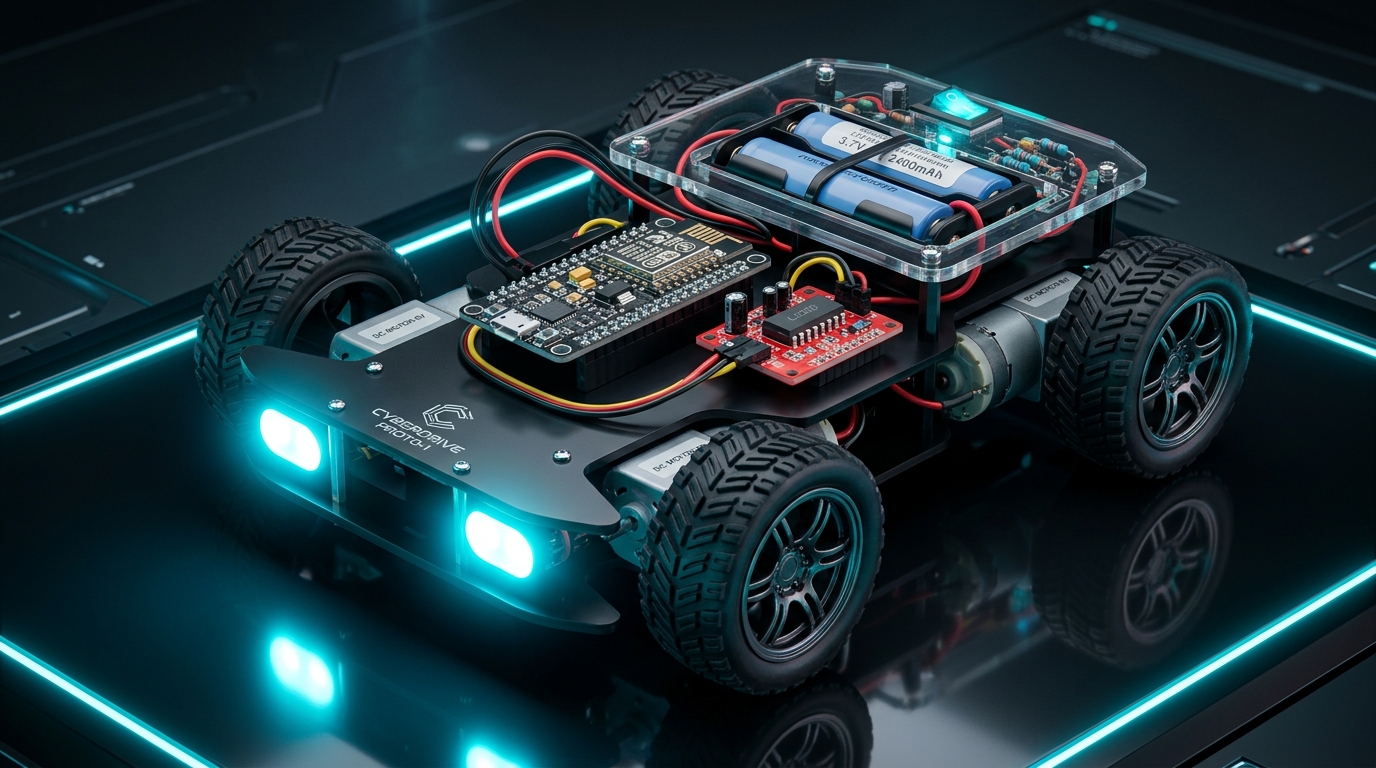
4-Step Execution Sequence.
Sub-20ms remote control pipeline over local Wi-Fi station network.
Wi-Fi Socket Handshake
ESP8266 NodeMCU connects to local AP, binds static IP, and initializes persistent TCP socket with Blynk cloud server.
Virtual Pin Decoding
Blynk mobile app triggers Virtual Pins V0 (Forward), V1 (Backward), V2 (Left), V3 (Right), V4 (Stop) over 20ms stream.
L293D Logic Switching
GPIO pins drive dual H-bridge motor driver IC inputs (IN1-IN4) to select forward/reverse current polarity.
Differential Steering
Twin TT DC gearmotors execute tank turns, speed modulation, and immediate emergency brake stop maneuvers.
Command Latency
Immediate directional execution (Forward, Backward, Tank Turns, Emergency Stop) using Blynk IoT Virtual Pin stream handlers over local Wi-Fi station network.
Robotic Hardware & Motor Control Specs.
ESP8266 NodeMCU V3
Wi-Fi SoC micro-controller operating at 80MHz with integrated IEEE 802.11 b/g/n radio transceiver.
L293D Motor Driver Expansion
Dual H-Bridge IC providing bidirectional DC motor control up to 600mA continuous per channel.
Twin TT DC Gear Motors
1:48 gear ratio dual shaft motors providing high torque output for obstacle navigation.
2S Li-Ion Power Battery Pack
Dedicated high-current discharge battery powering motor rails and NodeMCU 3.3V LDO regulator.
Blynk IoT Mobile Control UI
Custom smartphone touch interface mapping directional touch buttons to instantaneous microsecond commands.
Differential Steering Matrix
Allows 360-degree zero-radius tank spinning by running left and right motors in opposite directions.
Wi-Fi Telemetry & Motor Control.
The ESP Car platform bridges low-level hardware actuation with cloud/local smartphone telemetry. Built as a flagship Ugam Campus product project, the NodeMCU listens for incoming Virtual Pin triggers (`BLYNK_WRITE(V0)` through `V4`) over a persistent socket connection to drive high-side and low-side H-bridge logic.
// Blynk Virtual Pin Control Handlers
BLYNK_WRITE(V0) {
  if (param.asInt()) moveForward();
}

BLYNK_WRITE(V2) {
  if (param.asInt()) turnLeft();
}

// L293D Motor Drive Logic
void moveForward() {
  digitalWrite(IN1, HIGH); digitalWrite(IN2, LOW);
  digitalWrite(IN3, HIGH); digitalWrite(IN4, LOW);
}